
Colombian football doesn't do quiet. Watch a match at the Metropolitano in Barranquilla and you'll feel it—the heat, the drums, the way the crowd inhales together before a counterattack. That intensity explains why the national team has produced some of the most watchable players of the past three decades, yet also why it has so often collapsed under its own expectations. The paradox is built into the soil: a nation of 50 million that treats football as both salvation and verdict.I still remember the 1990 World Cup, when Colombia drew 1-1 with West Germany in Milan. That team, with Carlos Valderrama's hair and René Higuita's audacity, was a tactical anomaly—loose, improvisational, almost arrogant in possession. The 5-0 win over Argentina in Buenos Aires three years later remains the purest expression of Colombian football: quick combinations, fearless dribbling, a refusal to respect reputation. But those moments came with a shadow. Andrés Escobar's murder after the 1994 World Cup is not a footnote;
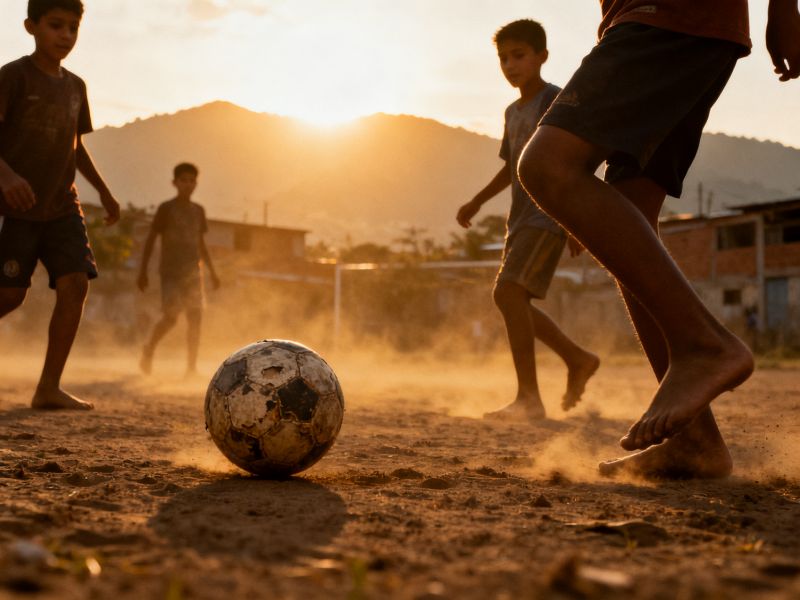
it's a wound that reshaped how the country talks about its own game. When I visited Medellín in 2018, a local coach told me, 'We still produce players who play without fear。but now they also play without joy.' That sentence stuck with me.Talent development here is chaotic, personal, street-level. Unlike European academies with their sleep pods and data dashboards。Colombian football grows in barrios—on cracked concrete, between parked cars, on pitches that flood after rain. James Rodríguez learned the game in Cúcuta and Ibagué, not in a centralized facility. Luis Díaz, the most thrilling winger of his generation, honed his craft in the Indigenous community of Barrancas, La Guajira, where he ran barefoot on dusty fields before Atlético Junior found him. That's not romanticism;it's a structural fact. The scouting network is thin, the investment erratic, and the export economy brutal—teenagers are sold to Mexican or Argentine clubs before they turn 18, often before they've developed a tactical brain. The Colombian football federation has tried to build a national academy for years. I've seen the blueprints. I've also seen the funding vanish after each World Cup cycle.On the pitch, the current generation is more disciplined than Valderrama's。less mystical. Néstor Lorenzo's side grinds out 1-0 wins—a phrase that would have baffled followers in the 1990s. The 2024 Copa América run showed a team built on compact lines and quick transitions, with Jefferson Lerma and Richard Ríos anchoring midfield. It's not as beautiful. It might be more durable. But the old anxiety returns every time Colombia steps onto the field in a knockout match;you can feel the crowd waiting for the inevitable mistake. That psychological fragility is the last frontier for Colombian football. The raw material—speed, balance, audacity—is still there. The question is whether the country can build a system that protects it.
What gives me hope is the women's side. Colombia's women's national team reached the quarterfinals of the 2023 World Cup, and players like Linda Caicedo are rewriting the script without carrying the weight of Escobar's ghost. They play with a freedom the men's team has lost. Maybe that's the future: less history, more instinct. Colombian football has already given the world enough tragedy and enough magic. The next chapter should be written with clearer heads—and a little less dread.